Hybrid cars first came into the market in 1997 as the Toyota Prius. Since then there are about 5 million hybrid vehicles out of 1 billion vehicles worldwide. ( less than 1% )
Hybrid cars uses half as much fuel as their petrol guzzling cousin, so why is sales penetration so low?
We can trace the problem to several reasons
1) Cost of vehicle : Hybrids generally cost 50% more than it's non hybrid model.
2) Rate of depreciation : Resale value of older hybrids are poor to non existent due to the high cost of hybrid battery replacements
3) Little desire for manufacturers to push this technology as they make more money selling their standard petrol vehicles.
4) Horror stories abound about how much owners have been quoted for repairing their vehicles.
This situation is absolutely ridiculous
We live in an age where our oil resources are depleting at an alarming rate and global warming is having a drastic effect on our environment. Every year brings record floods and droughts and our ice caps and glaciers are disappearing at an alarming rate.
Our vehicles are the major contributor to CO2 emissions into the environment and more should be done to reduce this.
Hybrid vehicles reduce CO2 emissions and reduce use of scarce resources.
1) Longevity of Hybrid vehicles : Hybrid vehicles will last at least twice as long as standard vehicles. We know that vehicles can clock up 600,000 Kms and more with very little deterioration in performance. This glaring fact has never been promoted to the public. This fact alone will reduce the demand on resources and reduction in emissions significantly.
The one problem that is consistently quoted is that the vehicle hybrid battery last 8 to 10 years and replacement is costly. There is a solution. Repairing and reconditioning of the hybrid battery and installation of the Power Jockey will enable the same original battery to be used throughout the life of the vehicles be it 25 years or more and it is no more expensive that yearly vehicle maintenance.
It's time to push the message that hybrid vehicles are not expensive to run and even less expensive to maintain.
How do we get the message across?
The best way is to show that older hybrids are still operating beautifully even after 15 years in service. Another is to push for it's use in an industry that is ideal for it. For this reason we are pushing for this vehicle to be be used exclusively in the vehicle rental industry. Customers will choose a hybrid over a standard vehicle because they save money on fuel. It is also the best way to get the general public to "test drive" this vehicle. I believe we will make a convert out of every hirer,
Monday, October 17, 2011


Friday, September 2, 2011
Buying An Estima Hybrid

Model : AHR10W
Dimensions : 4800L 1800W 1760H
Year Manufactured : 2002 - 200X
Petrol Engine : 2400cc
Electric Motor : 13Kw front, 18Kw rear
Transmission : CVT
Battery : 208.8 volts, 50 Kg
Weight : 1950 Kg
Fuel Economy : 14 Km/L
For those who don't know anything about and have never driven a hybrid - BEWARE.
Buy from a reputed dealer and one who knows and can support this new technology.
A hybrid is a great and reliable vehicle but because the electric motor and the petrol engine have to work together problems in engine side will affect the battery.
The Estima Hybrid is a 4 wheel drive vehicle. The rear wheel is powered by the 18Kw electric motor. Without a strong battery the vehicle will feel very much under powered. You can also damage the CVT transmission and engine if the battery is weak.
The Estima Hybrid is a 7 seater or 8 seater van but fuel consumption is half that of a regular petrol version Estima. There have been 2008 Estimas sold at auction in Japan that have done 600,000 Kms. This shows that when all parts are working correctly they are quite trouble free.
Look for the following
1) Vehicle must have a good reconditioned battery and a Power Jockey Installed.

2) Check to ensure that the vehicle is fully maintained and serviced.
Spark Plugs : 20,000 Kms if Irridium 100,000 Kms
MAF Sensor : 80,000 Kms
Oxygen Sensors : 120,000 Kms
Service parts wear out and have to be replaced for the vehicle to operate efficiently.
If possible a scan should be done to ensure that the sensors are working correctly.
If you take care to inquire about these two aspect of the vehicle, you can be assured that the vehicle will work for many years. The Battery Clinic assures us that the battery pack can last the life of the vehicle with the occasional battery repair and cell replacement every 2 to 3 years costing about $400.
The Petrol engine is tough and very reliable. It should be able to clock up 500,000 Kms and still show little wear and tear. For one the engine does not work all the time and it red lines at 4000 RPM compared to a normal petrol engine at 8000 - 12,000 RPM. Wear and tear compared to a standard vehicle is less than half.
The Electric motor will easily last the life of the vehicle. In 6 years of working with these vehicles I have not seen any motor fail.
Spare parts are available from wreckers and are well priced. Don't fall for those astronomical prices quoted for new parts by Toyota dealers. They are priced not to sell.
Buying A Generation Three Prius

Model : NHW20
Dimensions : 4445L 1725W 1465H
Year Manufactured : 2003 - 200X
Petrol Engine : 76Hp, 1500cc
Electric Motor : 67Hp, 295 Nm torque
Max RPM : 5000, ( 0 - 100 ) 10.5 Secs
Battery : 201.6 volts, 45 Kg
Fuel Economy : 22 Km/L or 4.8L/100Kms
For those who don't know anything about and have never driven a hybrid - BEWARE.
Buy from a reputed dealer and one who knows and can support this new technology.
A hybrid is a great and reliable vehicle but because the electric motor and the petrol engine have to work together problems in engine side will affect the battery.
The Generation 3 Prius is a hatchback. It is a little longer and wider and more powerful than the Generation 2. As the new modular cell packs are used, these are easily available and there is no issues in getting replacement cells for the foreseeable future. The generation three cost a few thousand more than the Generation Two but if your budget can accommodate the extra cost it will be worth it.
As the battery voltage is boosted to 500 volts a weak battery reduces the boost voltage available and increases the current which can damage the inverter. It is important to ensure that the battery is always in good working order.
Look for the following
1) Vehicle must have a good reconditioned battery and a Power Jockey Installed.

2) Check to ensure that the vehicle is fully maintained and serviced.
Spark Plugs : 20,000 Kms if Irridium 100,000 Kms
MAF Sensor : 80,000 Kms
Oxygen Sensors : 120,000 Kms
Service parts wear out and have to be replaced for the vehicle to operate efficiently.
If possible a scan should be done to ensure that the sensors are working correctly.
If you take care to inquire about these two aspect of the vehicle, you can be assured that the vehicle will work for many years. The Battery Clinic assures us that the battery pack can last the life of the vehicle with the occasional battery repair and cell replacement every 2 to 3 years costing about $400.
The Petrol engine is tough and very reliable. It should be able to clock up 500,000 Kms and still show little wear and tear. For one the engine does not work all the time and it red lines at 4000 RPM compared to a normal petrol engine at 8000 - 12,000 RPM. Wear and tear compared to a standard vehicle is less than half.
The Electric motor will easily last the life of the vehicle. In 6 years of working with these vehicles I have not seen any motor fail.
Spare parts are available from wreckers and are well priced. Don't fall for those astronomical prices quoted for new parts by Toyota dealers. They are priced not to sell.
Buying A Generation Two Prius

Model : NHW11
Dimensions : 4305L 1595W 1465H
Year Manufactured : 1997 - 2000
Petrol Engine : 44Kw, 1500cc
Electric Motor : 33Kw, 258 Nm torque
Max RPM : 4500, ( 0 - 100 ) 13.0 Secs
Battery : 273.6 volts, 52 Kg
Fuel Economy : 21 Km/L or 4.9L/100Kms
For those who don't know anything about and have never driven a hybrid - BEWARE.
Buy from a reputed dealer and one who knows and can support this new technology.
A hybrid is a great and reliable vehicle but because the electric motor and the petrol engine have to work together problems in engine side will affect the battery.
The Generation 2 Prius is slightly roomier and more powerful than the Generation1. As the new modular cell packs are used, these are easily available and there is no issues in getting replacement cells for the foreseeable future. These cost a few thousand more than the Generation One but if your budget can accommodate the extra cost it will be worth it.
Look for the following
1) Vehicle must have a good reconditioned battery and a Power Jockey Installed.
2) Check to ensure that the vehicle is fully maintained and serviced.
Spark Plugs : 20,000 Kms if Irridium 100,000 Kms
MAF Sensor : 80,000 Kms
Oxygen Sensors : 120,000 Kms
Service parts wear out and have to be replaced for the vehicle to operate efficiently.
If possible a scan should be done to ensure that the sensors are working correctly.
If you take care to inquire about these two aspect of the vehicle, you can be assured that the vehicle will work for many years. The Battery Clinic assures us that the battery pack can last the life of the vehicle with the occasional battery repair and cell replacement every 2 to 3 years costing about $400.
The Petrol engine is tough and very reliable. It should be able to clock up 500,000 Kms and still show little wear and tear. For one the engine does not work all the time and it red lines at 4000 RPM compared to a normal petrol engine at 8000 - 12,000 RPM. Wear and tear compared to a standard vehicle is less than half.
The Electric motor will easily last the life of the vehicle. In 6 years of working with these vehicles I have not seen any motor fail.
Spare parts are available from wreckers and are well priced. Don't fall for those astronomical prices quoted for new parts by Toyota dealers. They are priced not to sell.
Wednesday, August 31, 2011
Integrating Solar Power Into Existing Home
The first problem we have when we start generating solar power say with 1 panel, a controller and a 95 ah battery is to deploy the power for use.
In a motor home or caravan it is a simple matter of connecting the battery to a 12 volt light bulb or bulbs and you have light. You could also run the system in a garage and wire up the garage for 12 volt lighting.
What if we want to use the power we generate in our own home with our existing 240 volt wiring. The only choice is to set up a grid connect system. This is where the power we produce is fed to the grid for which we are paid by our electricity supplier and we are charged for the power we use. Usually there will be a difference between what we are paid and what we are charged.
Seems simple but there is the administrative red tape that we have to go through. We will need permission from our line company to connect to their grid and a contract with our eectricity supplier to pay us. These are not problems in themselves as the regulations do not allow them to refuse our request. However.......
First we need a grid connect inverter. This is not just any inverter it is an inverter that will match the phase of the power you produce to that of the grid. It will also shut the power off if the grid is down so that worlers working on the lines don't get electrocuted. Of course it is expensive. Expect to spend upwards of $5000 depending on the power required. You will also need an export meter that is supplied by the supply company for which you will be charged.
Oh-Oh but lets say you decide that you want to do it anyway well your simple setup above will not suffice. Lets say you expand your setup to producing 1 kilowatt a day which is about 100 watt of panels. Say you are paid 20 cents per kilowatt (very generous) your income is 20 cents a day or $6 a month. Remember above that you will be charged for the export meter? Well lets say it is $20 a month! You are now paying the electricity supplier for the priviledge of selling them power!
What a dilema and a catch 22 situation. They should just allow us to connect into the grid and let the meter flow backwards. This however is illegal and it is also dangerous.
Never fear we have a solution that will solve this problem. The ACDC RG1 power regulator. This device allows you to connect your solar batteries to a household circuit be it the hot water system, power or lights. You use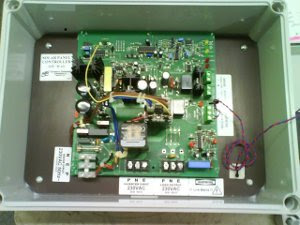 up the power you produced stored in your batteries and when the batteries are depleted the system switches over to the mains. When he batteries are fully charged again the system will switch back to the batteries.
 up the power you produced stored in your batteries and when the batteries are depleted the system switches over to the mains. When he batteries are fully charged again the system will switch back to the batteries.
This way you get full credit for the power you produce at the price your supply company charges you. You connect the system directly to you power circuit ( by a registered electrician ) using your existing house wiring.
For this system to work you will have to invest in a inverter to convert DC power in the batteries to 230 volt ac. The system is availiable in 24volt and 12 volt configuration. Generally inverters above 2000 watts are 24 volts. Components and cables for 12 volt systems are expensive for higher output because of higher current. Existing models of the DCAC RG1 are priced at $795.
Starting A Solar Power System
OK. You have heard all about solar power and alternative energy. You want to get started but don't know how or rather how not to do the wrong thing.
The first problem is cost - solar panels, solar controllers, batteries.
Solar Panels - monocrystalline, multi crystalline, amorphous. Panels vary from 1 watt to 180 watt cost from $10 to $2000
Solar Controllers - 12 volt to 48 volts 3 watts to 60 watts. Cost from $100 to $1000
Batteries - Flooded cells, Agm or Gel. Cost varies from $50 to $25,000
There are many uses for solar power some are the garden variety and small panels sold as top up's for batteries. Here I will concentrate on solar power that you can use in your motor homes or homes for lighting and power.
The most cost effective system
Panels - 40 watt amorphous is the most cost effective from a cost per watt basis. $395

Amorphous panels are resistant to shadows and work well in low light. These panels also easily fit into a larger grid system when you want to increase your power generation. Produces 240 watt a day.
Controllers - The Leonics 1206 is the best to use for a small maximum 2 panel system. $195
Batteries - Your standard car batteries are not suitable for solar power, however even a small 85 ah deep cycle battery can set you back $350. The good news is that a reconditioned 85 ah deep cycle battery can be purchased from the battery clinic for as little as $95 and it will work just as good.
OK there you have it a small solar system that you can use in the mobile home a batch or even in the home. Enough power is generated a day to light up 6 X 20 watt bulbs for 2 hours.

This solar streetlight is powered from 1 panel and is enough to light up a 20 watt bulb for 10 hours a day. The battery has enough storage for 3 days.
See www.thebatteryclinic.co.nz for more information
This is a quick start to producing solar power and it is a system that can be expanded easily.
Monday, August 29, 2011
Future of Hybrids - The hybrid battery
 If we can get a battery that last from between 16 to 20 years, the hybrid vehicle will be widely acceptance by the motoring public.
There are one billion cars in the world today and with many of the worlds most populated countries fast embracing vehicle ownership this number can only increase at a faster rate. However of this total only about 4 million are hybrids.
Most people know that hybrids uses less than half the fuel compared to a standard vehicle of similar size. So why is it the public have not taken to this new technology?
Two main perceptions holding this technology back are.
1) Hybrids are expensive : In Australia a standard Toyota Camry sells for A$ 28,988 and the Toyota Camry hybrid sells for A$ 36,990. It is about 27.6% more expensive.
2) When they break down hybrids are expensive to fix : The hybrid battery used in the vehicle is expected to last 7 to 10 years after which it is expected to be replaced which can cost about $4000. In anybody's book this is an expensive fix and it negates all the fuel savings made.
Should hybrids be more expensive to produce? Mass production could close the gap but even so, fuel savings will offset the higher cost of purchase. The main issue in getting hybrid vehicles accepted into the mainstream is the battery. What we need is a battery that can last the life of the vehicle. With the invention of the Power Jockey this is now a reality.

Every time a load is placed on the battery, it experience a dip in voltage which recovers after the engine kicks in. This dip in voltage gets deeper as the battery ages until the point is reached when a cell collapses and the battery fails. From the graph above we can see that this dip in voltage is averted when the Power Jockey is installed. It stands to reason that if the Power Jockey was installed from new, the battery can last more than the 7 to 10 years currently.
We are only installing the Power Jockey in vehicles where the battery has already failed which we have reconditioned and repaired. We have had batteries lasting more than 2.5 years after reconditioning and with the Power Jockey we are confident that we can make the original battery last the life of the vehicle. Extending battery life from 8 years to 16 years would be the biggest factor in overcoming the perception that the hybrid vehicles are expensive to fix when they break down.
Monday, August 15, 2011
Solar Water Feature
Most water feature used in landscape gardens uses 240 volt Ac converted to 12 volt Ac or DC. The mordern lanscape design should incorporate solar power to power Dc water pumps . Once installed it is completely self contained and the cost of running is zilch - nana - ZERO.
I have installed such a system in my garden. The first problem I encountered was that I could not get a Dc pump from the water feature supplier. Theirs was 12 volt or 24 volt AC and cost $150. I managed to obtained a similar capacity DC pump for $40 on the Internet. This worked perfectly on my water feature.
As I only needed the water feature to work in the day solar power was perfect as I had power for the water feature when the sun shorn.
Full setup and details of this water feature design below
Sunday, August 7, 2011
Battery Recycling In New Zealand
There is a war brewing in New Zealand about battery recycling and waste battery exports to Korea and the Phillipines.
First the background : Exide's battery recycling factory is the only one in New Zealand. Up until about 6 years ago New Zealand did not allow it's waste batteries to be exported. Exide had a monopoly and like any monopoly it took advantage. Scrap battery prices were set so low that it was not worth collecting them. Exide however made huge profits. However all this ended when exports were allowed and Exide had to pay market price for their raw materials.
Still this was not too much of a problem because Exide NZ was able to source batteries from it's Australian company Exide Australia. This situation also ended last year as Australian battery recyclers succeeded in stopping battery exports to New Zealand.
Today Exide recycling plant in New Zealand closed it's doors, citing lack of scrap batteries.... PERMANENTLY?
Voxy.co.nz
Thursday, 4 August, 2011 - 15:27
Exide's environmental record has been attacked in Parliament as the battery recycling plant faces possible closure as early as today.
First the background : Exide's battery recycling factory is the only one in New Zealand. Up until about 6 years ago New Zealand did not allow it's waste batteries to be exported. Exide had a monopoly and like any monopoly it took advantage. Scrap battery prices were set so low that it was not worth collecting them. Exide however made huge profits. However all this ended when exports were allowed and Exide had to pay market price for their raw materials.
Still this was not too much of a problem because Exide NZ was able to source batteries from it's Australian company Exide Australia. This situation also ended last year as Australian battery recyclers succeeded in stopping battery exports to New Zealand.
Today Exide recycling plant in New Zealand closed it's doors, citing lack of scrap batteries.... PERMANENTLY?
Voxy.co.nz
Thursday, 4 August, 2011 - 15:27
Greenpeace is calling on the government to come clean about exports of toxic waste from New Zealand to the Phillipines and South Korea.
OIA Documents passed to Greenpeace reveal that New Zealand has exported at least 50,000 tonnes of toxic battery waste to the Phillipines and South Korea since the end of 2008.
Greenpeace believes that serious question marks exist about whether these exports are legal under both the international Basel Treaty and Waigani Treaty, which make developed countries responsible for dealing with their own toxic waste rather than exporting it to countries where environmental and safety standards are lower
Greenpeace Executive Director Bunny McDiarmid said, "These revelations could threaten New Zealand's image both as a clean green country and a responsible member of the international community".
"If these deals are above board then why is the government withholding details of where in the Phillipines and South Korea our toxic waste is being processed?"
Greenpeace is calling on the government to:
? Release the names of the waste facilities in both the Philippines and South Korea where New Zealand's toxic waste is being processed and prove that their safety and environmental records were properly assessed before exports were approved.
? Put on hold any more exports of toxic waste until a full review of New Zealand's toxic waste management policy has been completed.
? Encourage development of a new state of the art recycling facility for New Zealand
Ms McDiarmid continued, "New Zealand has the moral responsibility to deal with its own toxic waste, not dump it on developing countries".
"The reality is we have the skills and technology to do this work cleanly and responsibly at home. The government should see this as an opportunity - to create new green jobs and investment."
"What New Zealand needs is a new state of the art recycling facility and one that isn't right smack bang next to people's homes and schools."
Stuff.co.nz
US execs making Exide ruling
TRACY WATKINS AND SHABNAM DASTGHEIBExide's environmental record has been attacked in Parliament as the battery recycling plant faces possible closure as early as today.
Sources close to the American-based company said a decision would be made in the United States early this morning on the Petone plant's future and that it could close its doors today because of a lack of work. It is not clear whether the closure will be temporary or permanent.
Exide workers told The Dominion Post last night that they had been instructed not to talk to the media. One said that message had been passed down "by management and the Americans".
Lawyers for Exide say it is being put out of business by the export of tens of thousands of used lead acid batteries to the Philippines and South Korea and that the shipments breach New Zealand's international obligations for the treatment of hazardous waste.
But Labour MP Trevor Mallard told Parliament it might be preferable to export the batteries than to keep open a factory with Exide's history.
That history included "explosions, causing damage to workers both by lead and the explosions, leakage at the boundary going into neighbours' [properties], a history of sickness of workers from lead poisoning [and] a history of dumping sludge in the Wainuiomata tip, then going into the Wainuiomata Stream", he said.
"There is no way that such a plant would be allowed to be located next to a residential area in most first-world countries, and it shouldn't be allowed here."
After questions in Parliament from the Greens yesterday, Mr Mallard also accused Exide of employing a "high-priced law firm" to get the Green movement onside in an effort to "save its bacon".
Exide has hired top public policy law firm ChenPalmer, which has lobbied the Government over its obligations under the Basel Convention, which requires countries to deal with their hazardous waste on-shore where possible.
Julie Wake and husband Steve have been living almost next door to the plant for 13 years. Mrs Wake said that if it didn't close, they would be forced to move.
"This is our first home together and we have invested our emotions into it, but we want to have children soon. This is not a place to bring up kids, they are more vulnerable to health issues than we are."
Mrs Wake said the community had actively campaigned for Exide to clean up its act for many years but the company had taken little on board.
Long-time campaigner Richard Whiteside said it was a no-brainer that the factory was endangering the health of the people of Lower Hutt and should be moved. "Recycling is a good thing, but why should we pay with our health?
"Even the Chinese are enforcing a buffer zone to residential houses of 500 metres. I believe this plant is the closest in the world to residential houses at just 50 metres and is only 250 metres from a children's playground and beach."
Environment Minister Nick Smith said he had begun a formal review of policy on battery shipments.
"My preference is for these batteries to be recycled in New Zealand, although I will need to be satisfied about the environmental standards, given the quite chequered record of the Exide Technologies plant in Petone."
He said in Parliament yesterday: "There have been substantive problems with ... resource consents in Petone and, given the toxic nature of lead, I think we would want to be strongly reassured of the plant's environmental performance."
Dominion Post
Exide lays environmental complaint
SHABNAM DASTGHEIB AND TRACY WATKINSBattery recycler Exide, which has often been criticised for its environmental record, has lodged a complaint against the Government, citing environmental concerns.
Exide, which closed for at least several days yesterday, has told the Parliamentary Commissioner for the Environment that granting Government permits to export used lead-acid batteries breaches New Zealand's international obligations and is thus illegal.
Sources close to the factory said it may close for at least part of next week because of a lack of work caused by used batteries being shipped overseas for recycling.
It is New Zealand's only plant for dealing with used lead-acid batteries.
In a letter to Parliamentary Commissioner for the Environment Jan Wright, Exide Technologies Australasian managing director John Cowpe said the export of the batteries was unlawful, "but more fundamentally is likely to result in significant adverse effects on the environment".
He said that, if New Zealand became dependent on other countries to dispose of hazardous waste and that export market market dried up, it would be left with uncollected waste and no facility to deal with it.
Wellington Scrap Metals director Brett Hall said he had tried to sell batteries to Exide in the past and it had refused to buy them directly from him.
"Every time we try and sell to them, they come back to us and say, `No, go talk to Macaulay Metals – who's quite a big competitor down here – 'and deal with them because they are the only ones we like to deal with down here'.
"The reason we export is we can get more for it. It's a free market, you can sell for the highest price."
Yesterday, Exide said: "Since 2009, there has been a marked reduction in the fugitive emissions of lead recorded at the boundary monitors of the recycling facility site. We believe these improvements will continue due to the enhancements made at our facility.
"We are proud of our 40 dedicated and hard-working employees at our facility and the work that is being performed to ensure the proper treatment and disposal of used lead-acid batteries for all New Zealanders."
But Labour's Trevor Mallard, MP for Hutt South, said Exide did not have a good environmental record and should be closed permanently.
"They certainly are the worst polluters in the Wellington region in recent years and I'm not prepared to support an economic model that is based on a factory that has regularly in the last decade emitted poisonous lead emissions in to the neighbouring residential community."
Using a Restored and Reconditioned Battery
Reconditioned Batteries Are Good For The Environment

To make a standard battery we use plastics for the casing, lead for the plates and terminals, lead dioxide for the active material and sulphuric acid for the electrolyte. All these are saved if we recondition and reuse this same battery.
But if they only last 3 months .......
Our record is five years for an automotive battery and even longer for storage batteries. Prior to us coming on to the scene people used to buy used batteries from car wreckers and other battery reconditioners. these batteries are still sulphated an only for 2 weeks to 3 months which gives rise to the perception that reconditioned batteries only last 3 months. A fully restored and reconditioned battery can last as long as a new battery. Our return rate is less than 1%.
But is it safe to use ?
Our desulphation process uses high frequency pulses to agitate the lead sulphate crystals breaking it's hard molecular bonds.This changes it to soft sulphate and allow it to take place in the chemical reaction again. The result is that we get a "Restored Battery" that is as good as new and often last 2 - 3 years. A restored battery is as good as a new battery.
Links
Cheap battery bank for an off grid power system.
[gwo-section id="Reconditioned batteries"][/gwo-section]

To make a standard battery we use plastics for the casing, lead for the plates and terminals, lead dioxide for the active material and sulphuric acid for the electrolyte. All these are saved if we recondition and reuse this same battery.
But if they only last 3 months .......
Our record is five years for an automotive battery and even longer for storage batteries. Prior to us coming on to the scene people used to buy used batteries from car wreckers and other battery reconditioners. these batteries are still sulphated an only for 2 weeks to 3 months which gives rise to the perception that reconditioned batteries only last 3 months. A fully restored and reconditioned battery can last as long as a new battery. Our return rate is less than 1%.
But is it safe to use ?
Our desulphation process uses high frequency pulses to agitate the lead sulphate crystals breaking it's hard molecular bonds.This changes it to soft sulphate and allow it to take place in the chemical reaction again. The result is that we get a "Restored Battery" that is as good as new and often last 2 - 3 years. A restored battery is as good as a new battery.
Links
Cheap battery bank for an off grid power system.
Save our planet and save money at the same time
Reconditioned batteries are not only for people on a tight budget. They are safe to use, can last as long as a new battery, and is good for the environment. Think about how much energy and raw material have been saved by recucling and reusing a reconditioned battery.[gwo-section id="Reconditioned batteries"][/gwo-section]
Subscribe to:
Posts (Atom)